Showing posts with label House Special. Show all posts

Friday, 20 May 2016

Top Dos and Don'ts for writing Book Reviews

By Gillian Hamer


As part of the Bookmuse arm of Triskele Books, I am proud that our work in supporting fellow authors was recognised by Goodreads last month, voting us one of their Top 1% Reviewers.

During a recent internal discussion about a new review we had received for consideration, it occurred to me that there is a real art and skill to producing a top quality book review. Something we have learned as second nature over time, does actually need a lot of thought and process to produce.

‘If you want to make an author smile, then review their book’ is something often seen quoted online. But in all honesty, a badly constructed review can often be worse than none at all.

I thought it might be helpful to other readers, new to reviewing, to put down a few of the unspoken ‘rules’ we follow when reviewing books for Bookmuse.

Here’s a summary of some useful Dos and Don’ts to consider:

DO

Try to stick to the 30% rule – that is to say have no more than a third maximum of the review made up of a resume of the novel. The reader wants to read it for themselves!

Stick to the job in hand – Whilst it’s fine to offer personal recommendations, keep to the book content and don’t meander off topic or bore readers. A location may well resonate with you but others won’t care where you spent your childhood holidays!

Have a list of questions you keep in mind when writing a review – and by the end of the piece try to answer as many of them as possible. Eg: Strength of characters, believability of plot, pace and style, dialogue and voice. Try to cover all of these in your feedback.

Remember why you’re writing the review in the first place – to inform prospective readers about your honest thoughts on the book. This isn’t about you, so you should take a back seat.

Support an author – remember not all books will be to your taste. That doesn’t mean you should hammer the book because of it. Keep that in mind along with the motto ‘if you can’t be nice, be polite.’ Writers are humans first and foremost.

Include comparisons if you can – authors need their egos stroking now and then. If a book really did put you in mind of another book by a bestselling, established author, don’t be afraid to say so.

Always be honest about recommending a book. That’s one of the best things you can offer an author.

DON’T

Never let your own personal tastes run away with you in a book review, trust me the reviewer usually comes out looking worse than the author.

Try not to call the author anything other than their full name or ‘the author’. Even if you know them it doesn’t need to be in the review, keep it professional at all times.

Avoid clichés and be original. The book may well be a ‘page-turner’ with a ‘nerve-wracking climax’ that was totes ‘unputdownable’ – but you can do better than that, right?

Take care with spoilers – there really is no need or excuse for them. You may have been shocked when the main character was killed in chapter one but does that need to be in a review? Even if you can’t be wholly positive about a book, there’s no need to spoil it for anyone else.

Never copy and paste the synopsis of the book into a review – it’s lazy and pointless. We all know how to Google!

Never use a book review as ‘payback’ for a poor review on another book – leave that to the schoolyard.

Never engage in debate about a negative review – smile, say thank you, and move on. If it’s your own book it can only end badly, and if you are trying to support an author, it only gives it more publicity.

Remember writers are human too – there are always ways to give negative feedback in a positive manner.

Finally, remember reviews are all personal opinion. You are entitled to your opinion just like anyone else. It doesn’t make you right or wrong. Your view is one among hundreds.

For a taste of our reviews, please sign up for our weekly Bookmuse newsletter here

Friday, 12 February 2016

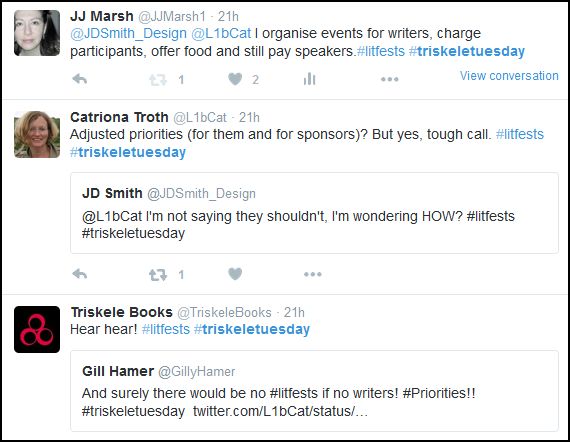
Triskele Tuesday #litfests

On Triskele Tuesdays, the team get online for an hour (19.30GMT) and discuss a current issue on the literature/publishing scene.

If you've not participated in one of our Twitchats before, simply search for #triskeletuesday and join in. All opinions welcome.

On Tuesday 9 February, the Triskele Twitchat tackled LitFests.

#triskeletuesday #litfests
We posed a few questions: why, how, who and what for?

The Human Library at Chorleywood LitFest

Which are the best 'little' litfests out there?

Twitter came back with a flurry of replies:

Hay-on-Wye
Harrogate
Chorleywood


@L1bCat recommended Not the Oxford Lit Fest
HNSOxford
Stokey LitFest


Crouch End
Wray Castle for children
@brixtonbard flagged up BareLit 


Lewisham
@JJMarsh1 mentioned non-UK Züriliest
CrimeFest in Bristol 
(where the bar is a crime scene in itself according to @sheilab10 and @ChrisLongmuir)


Should litfests pay their authors?
Or should writers be grateful for the 'exposure'?


And is festival programming broad enough?

 The consensus is that readers are ready for anything. The problem is programmers playing safe.


In summary, readers and writers are interested in variety. They attend litfests to find out more about the books and authors they love, and to meet other readers. Writers felt very strongly that if caterers and venue hire is paid for, why not offer remuneration to the main attraction? Sponsorship was mooted as one option. Another element not mentioned overtly but clear from the discussion was how much enjoyment writers get from meeting their readers and other writers.

Conclusion: there's life in the litfest yet.


Next #triskeletuesday twitchat will be on 23 Feb on the subject of #comfortreads


Monday, 7 December 2015

London Launch - Our photo album

We had a fabulous launch at The English Restaurant in Spitalfields, London on Saturday 28th November. We had fizz, books, fizz, food, fizz and actors reading from the new releases!

Full details of the event can be seen on our press release:
https://literallypublicrelations.wordpress.com/2015/12/01/international-author-publisher-collective-triskele-books-wraps-up-another-wonderful-year-with-hugely-successful-launch-party-in-london/

We'd like to share some of our favourite photographs of the day with you.


Relaxed and ready to party!
Rohan Quine reads from Human Rites

Amanda Hodgkinson reads from The Better of Two Men
Piers Alexander reads from False Lights
Jill and her family looking fab in Triskele colours
Don't they look fabulous!
Say Cheese!
Liza & hubby Jean-Yves!
Jessica Bell reads from Blood Rose Angel
Kat, Amanda, Sheila, Jane
Gillian & Amanda


Kat and Jane welcome Jane Davis & Sheila Bugler


We are also very proud to have made the weekly pictorial round-up in the Bookseller!

http://www.thebookseller.com/news/pictures-week-317917


Friday, 13 November 2015

In My Bottom Drawer (5) - Gillian Hamer

In My Bottom Drawer (5)


With a budding career as a new 'Queen of Crime', we put crime author, Gillian E Hamer, under the spotlight and demand she comes clean about the early manuscripts gathering dust under her bed.

With three paranormal thrillers under her belt - The Charter, Closure and Complicit - plus her latest crime novels, False Lights and Crimson Shore : The Gold Detectives I & II - she has already experienced the highs and lows that indie-publishing offers. Also, she has had a total of three literary agents in the past ten years, and so even in her early work, there must have been something that drew the eye to her writing.

But like all authors, she has novels that she would rather see hit the shredder than hit the headlines.


"THE STRANGER

Many many years ago, when I was a fledgling author (and I use that term in the very loosest sense) I decided I wanted to be a writer of erotica. After years of secretly reading my nan's Mills & Boon and Jackie Collins novels, I felt I was perfectly placed to unleash my new-found sexual powers on an unsuspecting world.

At the time I was dating a chef called James, who looking back I realise had one or two odd deviances, role play among the mildest. He also fancied himself as a budding Tolkien, so we decided to pool our 'talents' in a novel called The Stranger.

The premise was that we would write one chapter at a time, discussing only the vaguest of plots beforehand (two strangers meet, begin a journey together that would end who knew where... ) and wherever chapter one left off, the other writer would take on the baton and write chapter two, ending on a cliff-hanger for the other to take over in chapter three and so on.

Clearly, James had a different end goal to mine, and the novel soon bordered on illegal. I've no idea whether it remains gathering dust in some cyber-space email trash bin, but you can rest assured that's the best place for it.

MURDER, MILLENNIUM STYLE

I'll remain a little reticent about slating this novel, because it does have something, just not enough of anything specific. It was the first novel I wrote that I thought was professional enough to pitch to publishers (I don't think I knew literary agents existed back then) so I bought a 1999 Writers & Artists Handbook and sent the ms out to a long list of publishers - and unsurprisingly received a long list of rejection letters in reply.

One though caught my eye, it was the most encouraging input I could have hoped for and gave me a shred of belief in my writing. It was from a fiction editor at Hodder & Stoughton (as was) whose name I remembered many years later when I began to submit The Charter. She had moved to a literary agency by then, but remembered me as I'd remembered her. She became my first agent and helped bring on my writing in leaps and bounds.

So, although MMS remains buried in an old laptop somewhere, I reckon I may dig it out one day and see if I can shape it into something resembling a crime novel."

Friday, 28 August 2015

In My Bottom Drawer (3) - JJ Marsh


JJ Marsh is the next willing victim in our series to delve into the darkest past of successful authors, to see exactly where their storytelling gifts first developed.

Jill is the author of the brilliant Beatrice Stubbs series: Behind Closed Doors, Raw Material, Tread Softly, Cold Pressed and the forthcoming Human Rites (due out this November), which has a global fan base. Not to mention a reputation for quality writing and professional standards, topics she advocates across the independent publishing world.

But she wasn't always as polished and perfect. Where did her first attempts at the art of novel writing take her, and will any of these budding masterpieces ever see daylight again?

We delve into the bottom drawer of JJ Marsh and demand she reveals all ...


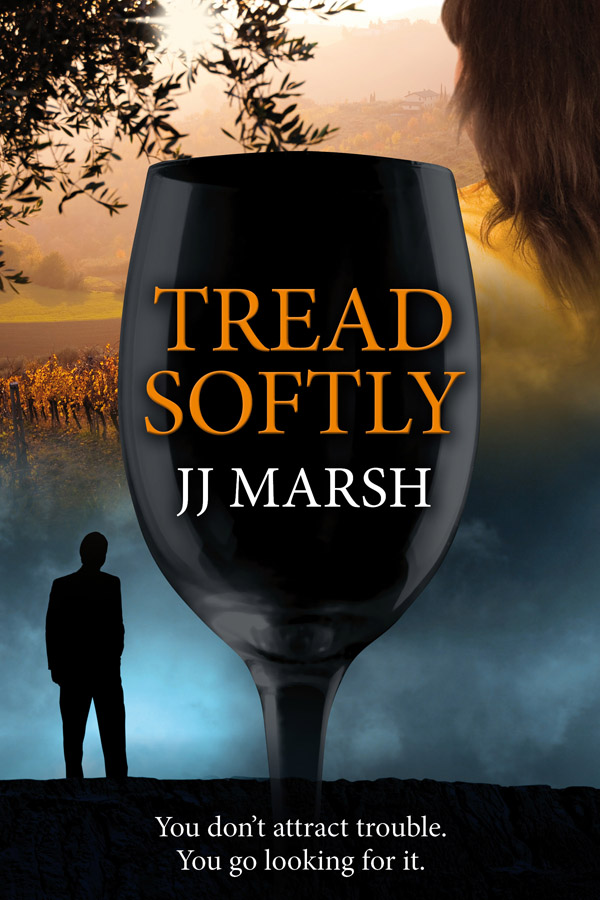
Tread_Softly_Cover_MEDIUM.jpg


"Three full novels sit in my bottom drawer.

One (Creed) was an oafish attempt at rewriting my own history. It should have gone on the fire years ago, but I keep it as a form of ballast. If someone emails me to say they love my books, or when I come home from a book club appearance glowing, or on the rare occasions I write a scene that makes me punch the air, I read a random sample of the novel formerly known as Creed (aka Crap). It’s the opposite of positive affirmation. I look at my writing self in the mirror and say, ‘You’re not all that.’

Two (Close) has something. Not what I thought it had, but an idea lurks beneath the first wobbling steps of I-got-adverbs-and-know-how-to-use-’em. Sadly, the end result was little more than flexing of new writing muscles. Much like learning to ride my motorbike, Close was a necessary and bruising phase, best kept off the streets.

Three (An Empty Vessel) is a cryogenically frozen embryo of an idea. With the right shot of reanimation juice, it may yet be resuscitated. It has a central concept I can't leave alone and range of characters whose voices call to me in the wee hours of the morning. ‘Don’t leave us unfinished... we’ve got a story to tell...’

I itch to apply all I’ve learned about writing to this book, but my gut feeling says that in order to do this story justice, I first need to learn more about myself."

Friday, 7 August 2015

In My Bottom Drawer (4) - Liza Perrat


Liza Perrat is a successful historical fiction author. Her first two novels, Spirit of Lost Angels and Wolfsangel, have won prizes and helped build a worldwide fan base who applaud the quality of Liza's writing and wait in anticipation for each new release.

And yet, like all writers, she has her writing secrets. In the fourth installment into our mission to uncover the hidden treasures and utter disasters nestling hidden on computer hard drives, we ask Liza where her passion for story-telling first began, and order her to come clean about those first scribbles she would much rather forget.

So, Liza, what do you have hidden in your bottom drawer ...


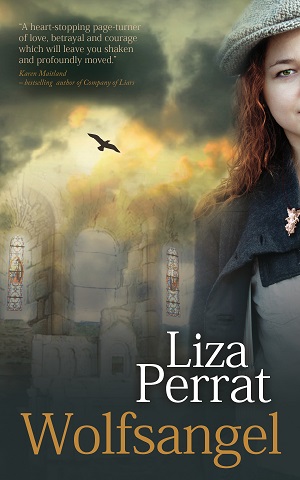
Wolfsangel_CoverFinal_EBOOKCopy1small.jpg


"I’d completed the Creative Writing course. I’d written a string of articles, several published in international magazines. I’d written enough short stories for a collection, many of which won competition prizes and featured in anthologies. Right, I said to myself, I must be ready to tackle The Novel. 
A year and 100,000 words later, Wolf with a Red Rose emerged. It seemed to have everything: dashing, bad-guy hero, sorrowful heroine, suspenseful plot-line, murder and mayhem, and a gorgeous French countryside setting, including lashings of wine and food.
Blissfully unaware of the clichés, the stilted dialogue, the semi-autobiographical element, I eagerly posted it to over a hundred agents and publishers. Five requested the whole manuscript. Four of those rejected it; the fifth turned out to be a vanity publisher. 
What is wrong with this, I asked myself. I couldn’t answer that, but I wrote another novel––Hosing Venetian Blinds––also heavily autobiographical, and including enough poorly-disguised neighbours, friends and relatives to potentially land me in a lot of trouble. This novel was a little more successful though, and landed me an agent. “Nice writing,” she said, “but the whole plot needs redoing.”
I’d already spent two frustrating years rewriting Hosing Venetian Blinds, but just couldn’t get it right. I knew that (besides the plot) there was something dreadfully wrong with it, but still I couldn’t put my finger on it.
Then, for reasons unknown to me, I fell into writing historical fiction. I was no reader or fan of this genre, but suddenly found myself writing a novel set in 18th century France. And voilà, I discovered that in writing about the past, I'd stumbled upon my all-elusive “voice”; something I then knew was clearly missing from those first two novels.
Am I more comfortable writing about times gone by, rather than in modern-day settings? Were those first two novels simply part of the all-important learning arc of novel-writing? Probably a bit of both. 
I might have found my “voice” in historical fiction, though it’s still a rough, untamed voice. I’ll soon publish my 3rd novel, but I’m still learning from each new book, striving to make it better than the last. And every so often I open my bottom drawer and glance at Wolf with a Red Rose and Hosing Venetian Blinds. I smile affectionately to myself, try not to cringe, and shut the drawer."

Friday, 3 October 2014

In My Bottom Drawer (2) - Barbara Scott-Emmett

In My Bottom Drawer (2)


We continue our series of discovery with a look at the humble beginnings of new Triskele associate, Barbara Scott-Emmett. Not only is she the author of the forthcoming, highly anticipated literary novel, Delirium : The Rimbaud Delusion, she has published two thrillers, Don't Look Down and The Land Beyond Goodbye - as well as a series of erotica novels under her pen name of Barbie Scott.

Her writing has been applauded by competitions and critiques alike, and yet, like every writer out there, she has a 'first born' nestling in a dusty drawer somewhere that she would much rather forget existed.

Here, we force her to confront her demons and reveal all ...


"When I first started writing I thought everything I produced should eventually find a home. The thought of any of my wonderful work languishing unread was too painful to contemplate. As time went on of course, I realised some things were never destined to be inflicted on the public. My first two (or rather one and a half) novels for instance.

My first completed full length work was Lucifer’s Gift. I was proud of it. I read bits out at writing groups. I sent it off to agents and publishers. It came back with polite notes of rejection. I cursed these gatekeepers for their inability to recognise genius. And shoved the manuscript in a drawer.
My next venture into novel writing was going to be called The Villa of the Mysteries but it never got that far. I wrote a fair bit of it before I admitted to myself that it was banal and trite. It went in the back of the drawer with the first one.

After I published my subsequent novels, I dragged my early attempts out to see if there was any way of resurrecting them. And cringed. Did I really send this adverb-ridden self-conscious twaddle out to publishers? I wanted to hide myself away in embarrassment.

Once I crawled out from under the bed I shredded the manuscripts, wiped the disks and removed all evidence of my shame. Thank goodness self-publishing wasn’t around in those days and the number of people who suffered was limited to a few kind-hearted friends. Writing those first two novels was necessary and useful – they were my ’prentice pieces, my practice runs. I learned from them and got better and that’s what early work is for.

The moral of this story is: Don’t Publish Too Soon."

Friday, 1 August 2014

In My Bottom Drawer (1) - Catriona Troth


In My Bottom Drawer (1)


All writers have a 'first' novel buried deep in a drawer somewhere, many that will never see the light of day, let alone face the publishing world. Some may be hidden gems, many will be steaming piles of excrement, but facing up to your humble beginnings can be a revitalising experience for a writer.

In a series of articles, Triskele authors bravely discuss the contents of their bottom drawers.

We start with author of Gift of the Raven and Ghost Town, Catriona Troth.


"The first time a sat down to write an entire novel, I was a post-graduate student. I was, of course, supposed to be doing something completely different, but as a colleague of mine memorably announced one morning, “the frontiers of science put up barbed wire last night.” I was bored, frustrated, and spending more time in the literature section of the university library than the maths and engineering section where I belonged.

The book I set out to write – first on my brand-new Olivetti typewriter and later on my state-of-the-art Amstrad PCW – was basically a love triangle. But it had ideas way above its station. The title, The Broad Continent, was taken from a Virginia Woolf quotation - “Across the broad continent of a woman's life falls the shadow of a sword...” I was convinced I was writing a feminist masterpiece, on par with the Virago Modern Classics I devoured by the sackload.

By rights, the whole thing should have been consigned to history along with the PCW. But my techy husband found a way of converting the files, so I still have a copy of it on my computer. When I look at it now, it screams pretentiousness, naivety about human nature, and amateurish writing. As for the dialogue – let’s just say I was channelling my beloved Dorothy L Sayers.

Perhaps the most interesting thing about this early adventure into writing is what it tells me about how the publishing industry has changed. This overblown and faintly ridiculous manuscript received (among other things) a full reading from an editor at Macmillan who, though he rejected it (thank God), wrote a long and detailed response that I still have tucked away in a file somewhere. Ah – those were the days!"

Friday, 27 June 2014

Time and Place


Triskele writers share their passion for time and place, plus some favourite books which have all three.

Barbara Scott Emmett

Why Rimbaud and the journey of his missing manuscript? Why there and why then?

Two French poets – mad, drunk, scruffy and wild – how could anyone resist them? I fell in love with Rimbaud the first time I saw a picture of him in a display about his time in Camden Town with his lover Paul Verlaine. When they fled to London they left behind both Verlaine’s young wife and Rimbaud’s long poem La Chasse Spirituelle. According to Verlaine it was the best thing Rimbe ever wrote. Sadly, as it’s been missing for over a hundred years, that can’t be verified.

But what if someone found it? My speculations about this possibility suggested the main idea for Delirium: The Rimbaud Delusion.

I first visited Rimbaud’s home town in 1993 and have visited several times since. Charleville-Mézières is an ordinary medium sized town in Northern France, pretty without being spectacular, neat and bourgeois and full of civic pride. Rimbaud hated it – and said so (often scatalogically) in his letters. The idea of setting the main part of my novel there was irresistible. I loved the idea of the bizarre goings-on and hallucinatory experiences of the narrator, Andrea, being set against this formal and slightly conservative backdrop. Most of the places Andrea visits do really exist – the quiet river Meuse, the cobbled main square, the public gardens near the station – and in every one of them something strange happens. I set the novel in 2004 because that was the last time I went there and the town was starting to become more modern, more generic. I wanted to pin Charleville-Mézières in place before it changed any further though, inevitably, imagination and distorted dreams will have transformed the town into my own version of it.

Which book from your shelf do you feel demonstrates a strong sense of time/place?

The 18th century Venice of Scherzo by Jim Williams is quite possibly not at all like the real thing but it is a wonderful version of it. Hallucinatory and filled with intrigue, La Serenissima hides in the mists and miasmas that hover over her canals and seep into her alleyways; her citizens creep through her streets cloaked and masked. Dark deeds are performed by hidden hands and mystery abounds. Scherzo is ostensibly the story of a murder and its investigation but it is so much more; it is the evocation of a particular time and a particular place brought to life in more fascinating detail than mere brute reality could provide.

Catriona Troth

Is heritage and ancestry an important theme for you?

Maybe because I had such a peripatetic childhood, I always have a sneaking suspicion that people with deep connections to their roots have something that I’m missing. It would certainly explain why I identify so strongly with my Welsh heritage, even though I am only half Welsh, have never lived in Wales and don’t really speak the language. My grandmother (my ‘nain’) lived with us when I was growing up, so I heard Welsh being spoken all the time and could follow the gist of a conversation. I grew up with Welsh stories and the poetry of Dylan Thomas – and above all, with the (sloe black, Bible black) Welsh humour ringing in my ears.

So, yes, to actually answer the question, I do like to explore how characters connect with – or kick against, or try to rediscover – their various backgrounds.

Which book from your shelf do you feel demonstrates a strong sense of time/place?


A sense of time and place is something that I really connect with when I am reading a book. But I am going to pick one that maybe not so many people have heard of – and I choose it, not least because the author, like me, became a Canadian immigrant. It’s The Cowards by Josef Škvorecký.

The Cowards is set in a little town on the border between Slovakia and Germany, in the dying weeks of the Second World War. It perfectly captures what it’s like to be a teenager - self-obsessed, image conscious, writhing with hormones and muddled ideals. When all that comes hard up against the brutal realities of war, it’s as if Holden Caulfield has walked into the pages of Catch 22. It’s a book that deserves to be much, much better known.


Gillian Hamer

Is there any particular reason you choose to set your novels around North Wales and the island of Anglesey?

My dad has always loved North Wales. We think it's in the genes as his family are supposed to be from there originally. We ventured onto Anglesey when I was about ten. The first holiday I got mumps and it rained every day. Not the best start. But with good weather, nowhere in this country can beat the island. I adore the sea. It has echoes of Cornwall, the most stunning scenery, and an immense amount of history and legend which appeals to me as a writer. I find it so much easier to relax and write up there. Besides, it's a better option than writing about Birmingham!

Which book from your shelf do you feel demonstrates a strong sense of time/place?


I'm going to go with Sarah Waters - The Little Stranger. She is maybe not an obvious choice and it's not a particularly strong locale. I do like books that make you ache to visit a location, equally I like writing that burrows into a time and place and examines it so minutely that it brings it to life in your head. And in The Little Stranger not only is there an intense atmosphere throughout but the period and the landscape and in particular that house are so vivid and real. It stays with me. Brilliant writing.


JD Smith

Why did you choose to re-tell the story of Tristan & Iseult? What attracted you to their story?

All legends appeal to me, particularly those of which we know so little. The story of Tristan and Iseult (or Isolde) first appeared for me in Bernard Cornwell’s Arthurian trilogy. He interwove their tale so believably into a unique take on the history of Briton that I looked them up and discovered the various different accounts of the tale. Then when the film Tristan and Isolde, produced by Ridley Scott, hit the big screen, my interest in the tale was revived. I began writing my version shortly after I began writing the second in my Warrior Queen series, (Overlord, The Rise of Zenobia) which is based on third century Palymrene Queen Zenobia. I was hankering after writing something closer to home, about the wet and windy wild that is Britain.


Which book from your shelf do you feel demonstrates a strong sense of time/place?

Just one? Bernard Cornwell’s The Winter King plus so many more …


JJ Marsh

Which comes first, story or location? And which particular features create a sense of place?

Story, always. Or at least the bare bones of the plot. Then I audition various places before beginning to write. I have to know the setting, even before populating the novel with characters. The place IS a character.

I start with the senses. We notice sights, sounds and smells first, and add to our impressions with tastes and textures, all the while comparing them to our expectations. Food and drink are essential, as they reveal something of the region but also much about the characters. Cultural differences have to be treated with great care in fiction. Lumpen great dumps of information are poison to pace. But subtle observations can be woven into the story, provided they are relevant. I’ve just abandoned a book set in Rome which was clumsily pasted chunks of guidebook against a sub-par Eat, Pray, Love plot. The reader wants to be immersed in the storyworld, not subjected to the author’s holiday snaps.


Which book from your shelf do you feel demonstrates a strong sense of time/place?

Place: The White Woman on a Green Bicycle, by Monique Roffey. I know no other location which assumes its rightful place in a list of characters than Trinidad in this book.

Time: The Grapes of Wrath, John Steinbeck. Superb depiction of circumstances and their effects of human nature.


Liza Perrat

How do you go about evoking the atmosphere of a place?

My novels are set in the French rural area in which I live, which makes it much easier to evoke atmosphere. I take loads of photos of the countryside, the people and the buildings, during each different season. The local historical association has lots of sketches and documents on what it looked like through the ages. As I walk the dog, I jot down descriptions of sunrises, sunsets, stormy light, fruit on the trees, snow on the hills, flowers in spring and the icy river in winter.

Landscape, culture and food, certainly. But most of all, for me, it is the people who create a sense of location. Often, the people are the place. Also language, especially expressions, plays a part. Architecture too, gives a feel for a place.

Which favourite book on your shelf demonstrates a real sense of time and place?


Ooh, that’s a hard one; that goes for so many of my favourite books. But what comes first to mind is Kate Grenville’s Sarah Thornhill and The Secret River. I really felt I was back in early 19th century colonial Australia.