Friday, 22 July 2016

Creative Spark Week 4 - Point of View

Creative Spark Week 4 - First Person Point of view
By Amanda Hodgkinson


As we all know, Nabokov’s famous novel Lolita, is written from the POV of Humbert Humbert, the man who pursues Lolita. That’s to say, the novel’s story is told to us by Humbert Humbert. We hear his version of events. His voice. And Humbert, we soon learn, is an unreliable narrator. But what if Nabokov had decided to write the novel from the point of view of Lolita herself. One thing is sure, it would be a very different story…


Clearly, the writer’s choice of point of view is crucial. For this exercise on POV think of Cinderella. Traditionally, the story focuses on motherless, down on her luck, sweet and modest, Cinders. She searches for happiness in a world where everybody, it seems, is out to thwart her goals. But is that really the case?

Spend a few minutes thinking about a possible opening scene from the story. Now, write a few paragraphs from Cinderella’s POV. Use her voice as you hear it. Use the word ‘I.’ Let us really hear who Cinderella is – What kind of accent does she have? How does she see the world? What are her desires? Is she really dreaming of marrying a prince? Or does she dream of other goals? Go with whatever comes into your head. Surprise yourself. What story does Cinderella really want to tell?


Now write a scene, or perhaps the same scene, in another POV. What happens to the story if we hear it through the voice of the fairy godmother? How does Cinderella’s Stepmother tell the story? Or the prince? Remember as you write, first person POV, is exactly that. We can only know for sure what the ‘I’ of the narrator sees and thinks and hears. We cannot go into another character’s head and hear their inner thoughts.


Now that you have tried out first person POV, I hope you can see that the narrator who tells the story in this way, using the ‘I’ form, will always focus on their own ‘angle’ of the story.

Amanda Hodgkinson's debut novel 22 Britannia Road became an award-winning international bestseller. Her new book Spilt Milk came out in February 2014 (Penguin Books) and her novella Tin Town was published in the Grand Central collection of stories (Penguin US) in 2014. Meanwhile she is working on a third novel... http://www.amandahodgkinson.com

All images courtesy of Julie Lewis

Friday, 15 July 2016

Creative Spark Week 3 - The Essence of Character

The Essence of Character
By Joanne Furniss

Some characters make it easy for you—they will walk into the room and stand beside your computer, drumming their fingers on the desk while you write their story. A teenage character in my first novel, The Lonely Steps, appeared like this; I spotted a girl being escorted by her doting boyfriend across a crowded swimming pool in Switzerland and she high-stepped into existence as Lola, my “girl out of time”. But other characters, like Lola’s mother, may be more bashful and need to be coaxed into reality.


The central question for any character—the reason they occupy space in your story—comes down to what do they want? There is a second part of this question: and what do they need? Chances are, your plot will involve denying them what they want in order to give them what they need, so you must be clear about these driving forces in their personality.

What does s/he want?

Exercise 1: Everyone has a secret. Most are not life-changing. So why do we decide that one particular incident / fact / mistake is so powerful, we keep it hidden?

So…

From the POV of your character, write a private letter or diary entry. The first line is: I have never told anyone this, but…


What does s/he need?

Exercise 2: Most people don’t know what they need in life—we’re too distracted by our desires—and your character is no different. Someone else can probably see into their heart more clearly than they see it themselves.

So…

Your character walks into a café / pub / restaurant to meet someone they know well, a friend or family member. There is also a waitress/ barman / cleaner. Write a 360° description of the scene from three POVs; how the friend sees the character, how the stranger sees the character, and how the character sees the scene. 

How do these conflicting wants and needs motivate your character?

We are all driven by desires and instincts. What your characters wants and needs will affect their every decision, consciously and unconsciously.

So…

Exercise 3: A brain-storming activity to answer this one question. The aim is to nail the issue of want / need into one clarifying sentence.


What wounded her early on in life and led her to believe a lie?

As an example, the answer to this question for my main character in The Lonely Steps is: Marlene believes that, because of her own frigid childhood, she doesn’t feel emotions deeply enough to be a good mother.

From this stage, you can develop a character arc—how your character will change (or stubbornly not!) during the story. Their actions within the plot will also be grounded in these deepest desires.


Jo Furniss is a British writer now based in Singapore. Her first novel, The Lonely Steps, is represented by the US literary agency Browne & Miller. A second domestic thriller, set in the glossy expat world of Singapore, is making progress. After working as a Broadcast Journalist at the BBC in the UK, Jo gave up the glamour of night shifts to become a serial expat and freelance writer. She is editor of www.swaglit.com, a magazine for writers in Singapore. 

All images courtesy of Julie Lewis

Friday, 8 July 2016

Creative Spark Week 2 - Plot and structure

Plot and Structure exercise
by Tracey Warr

Plot is the sequence of events that drives the story from its beginning, through it middle, to its end. ‘Somebody’s got to want something, something’s got to be standing in the way of getting it.’ (Sorkin in Yorke).

Plot plans can help you at two stages: generating the first draft and rewriting. ‘Writing is 10% writing and 90% rewriting’ (Smitley). Writing is more perseverance than inspiration. ‘Great stories fold over themselves at the midpoint and aspire to symmetry (Yorke).


Use the list of questions below as a guide-rope to spend 20 mins producing a 1-2 page max. plot summary, either of a novel or short story you have written, or one you are working on or planning to write. A few words/one sentence should be enough for each element. You are aiming for a bare bones summary. Complete as much as you can. Leave blank answers you can’t figure out quickly.


1. Who is the Hero/Heroine?

2. What are their characteristics (good and bad)? (four words)

3. What is their ‘ordinary’ world where the story begins?

4. What do they think they want – their stated want?

5. What do they want that they don’t yet realise - their inner need?

6. What happens to start the action that changes the Hero’s world for ever?

7. What is their goal now?

8. How does the Journey/story get underway? Does a friend(s) team up with Hero? What seemingly insignificant object might Hero acquire that proves important later?


9. What secondary character does Hero meet who is more familiar with the changed world and mentors and assists Hero?

10. What first three trials test and deepen Hero and allies’ relationships?

11. Everything is going well and Hero’s goals look likely to be realised but then someone yanks the rug out from under them – how?

12. The Hero does not give up and realises their inner need but thinks it’s possible to have both stated want and inner need.

13. What second three trials test and deepen Hero and allies’ relationships?

14. Someone or something very precious to the Hero dies (doesn’t have to be literal). Who/what?

15. The Hero wants to give up, going through the stages of grief – denial, anger, bargaining (I would be a better person if …), depression, acceptance.

16. Someone or something gives the Hero new inspiration (the seemingly insignificant object may come into play). What? The Hero has an epiphany, abandoning their stated want and going all out for their inner need.

17. Reconciliations/relationship problems are cleared up – how/what?. An attack on, or ambush of, the problem is planned – what?

18. Something totally unexpected happens – what? forcing the Hero to make the final choice, a choice the Hero would never have made if put in this situation at the beginning of the story.


When you have filled in as much as you can, study your answers. Spend 10 mins thinking about how you might develop or change this to enhance the drama of your story?


Further Reading

Booker, Christopher (2004) Seven Basic Plots, A & C Black.

Smitley, Adron J. (2011) A Stranger Comes to Town: 13 Essential Steps for Plotting Your Novel, Create Space Independent Publishing Platform.

Vogler, Christopher (2007) The Writer’s Journey: Mythic Structure for Storytellers and Screenwriters, Michael Wiese Production.

Yorke, John (2014) Into the Woods: How Stories Work and Why We Tell Them, Penguin.

Find out more about Tracey and her work here: http://traceywarrwriting.com

All images courtesy of Julie Lewis

Friday, 1 July 2016

Creative Spark Week 1 - Story Fundamentals

Welcome to Creative Spark!

Triskele Books tried out a self-sourced creative writing course last summer.
We loved it. Now we've refined and honed and gathered support, and want to share with you.

Ten weeks of creative writing exercises from professional writing tutors, each focused on a particular element of fiction writing.
We don't want your money. We don't even want your email address.
This is FREE.

For ten weeks, every Friday, we'll post an exercise or two on a particular theme.
Each post is designed to last no longer than half an hour, but trigger ideas lasting so much longer.
Share your thoughts in the comments or keep it to yourself. Up to you.

Have fun! We did.

With grateful thanks to Ingram Spark and all our contributors.


Story Fundamentals Exercise
By Emma Darwin

A story is built of people who act, and what makes us keep reading is that they act in ways which we can believe, for reasons we can believe in. But it’s not always easy to hit on that story-driving combination of convincing actions in a convincing world, so this exercise starts with the most basic job: evoking physical convincingness, and develops outwards from there.


1) Think of an object which you’ve never seen, but know must exist or have existed. It might be a toy your German grandfather left behind when he came to England on the Kindertransport, the gun that was used to assassinate Anwar Sadat, or the fridge on the Space Shuttle.
Don’t worry about being accurate.
Make notes to evoke its physical presence.
Make sure you’ve checked in with all six senses including kinaesthesia (what’s it like to pick up, hold, throw, sit on?).


2) Our first, default ideas are often the least likely to bring out the best writing, so start imagining outwards from that moment in the object’s life. Where else might it have been? And where else again?
Maybe your grandfather’s toy had been his grandmother’s. Maybe the gun was bought on the black market in Moscow. Maybe the fridge had to be specially imported from a tiny specialist company in Guatemala.


3) When you’ve found an atmospheric place, pick one of the people who owned or had custody of your object.
Write some notes to bring this Character A into focus: who they are, their job, personality and so on, and how they feel about the object.
Now, your character A must sell or give the object to Character B.


4) Start writing the scene at the point where they meet.
Does A want to or not? Is B willing to take it, or not?
What kind of negotiations or arguments might result? Does A get to hand it over, or not?

Good luck!

Emma

Novelist and creative writing tutor Emma lives in South London. Her latest book is Get Started in Writing Historical Fiction, while her novels have been long and short-listed for many awards. She also writes short fiction and blogs about writing at This Itch of Writing: the blog

All images courtesy of Julie Lewis

Friday, 17 June 2016

Announcing the Triskele Lit Fest 2016


A LITERARY FESTIVAL:

adventures in reading

Building on our experience of running two Indie Author Fairs, Triskele Books imagined our ideal Lit Fest. One word sums it up:

INCLUSIVITY!

Author panels to draw in readers eager to explore the world of books
Indie authors and trade-published authors on an equal footing on the same platform
BAME authors invited to talk about their books, not about diversity
Authors paid a decent fee for their appearance 

True to the founding principles of Triskele Books and Words with Jam, we knew it was up to us to make it happen.

So this year, alongside the trademark pop-up bookshop of our Indie Author Fairs, we will be staging a series of author panels, each focused on a genre popular with readers. The panels will bring together authors to discuss why they work in their chosen genre - what they love about it, what its challenges are, and their own favourite authors. 

Our Preserving the Unicorn panel will explore how editors and authors work together when the text, at first sight, defies conventional wisdom about how a narrative ‘should’ be put together. Ground-breaking novels, by their nature, break the rules. How does an editor work to hone such a text, without destroying the unique magic the author has created?

Supported by Matador Books and Ingram Spark, we bring you the first Triskele Lit Fest.

We look forward to welcoming you to Lift in Islington on Saturday 17th September.


Booking will open SOON for those who want a table in our pop-up bookshop.

Keep an eye on the Triskele Lit Fest blog.


In the meantime, you can view some of the exciting panellists we have lined up for you here.


Friday, 10 June 2016

Bookclub Discussion: A Greater World by Clare Flynn.

In June’s Triskele Book Club we review Clare Flynn’s novel A Greater World.

About Clare: Award-winning author, Clare Flynn is a former global marketing director. She now runs a successful strategic management company, although most of her time these days is spent writing her novels.
Amazon Description: “When Elizabeth Morton hears her father wants her to travel to the other side of the world to marry a complete stranger, she thinks he must have lost his mind. This is 1920 and a woman has rights - she might still be too young to vote, but she's not going to be treated like a chattel. But she's reckoned without the brother-in-law she's always despised, who brutally shatters her
comfortable world, so she has no choice but to sail to Australia.

When Michael Winterbourne, a Cumbrian lead miner wakes up with a hangover after his engagement celebrations, he has no idea he is about to be the cause of a terrible tragedy that will change his life and destroy his family. When Michael and Elizabeth meet on the SS Historic, bound for Sydney, they are reluctant emigrants from England. They may start to hope their troubles are over, but they'll find they're only just beginning. 

A Greater World is set in the early 1920s, a period of transition between the old pre-World War One way of life and the post-War, with the coming economic Depression, major social change and the evolving role of women in society. It moves from the dales of Cumberland and the docks of Liverpool to Sydney and the beautiful Blue Mountains.”

Okay, ladies. Time for your feedback.

1. Parting thoughts at the end of the book?

(GEH) That I wanted to know more! I found the book quite a slow starter for me and it took quite a while for me to bond with the characters. But by the end, I had connected. Elizabeth and Michael had such a difficult and traumatic journey to get to that point, they more than deserved some happiness, but I couldn't help but think there had to be more twists along the way!

(CT) There was a sense of satisfaction that, after all the twists and set backs, the characters had found their resolution.

(JJ ) Yes, satisfying and sad in some ways, as some characters I loved didn't make it all the way.

(LP) I sympathised with the main characters immediately, so found the ending satisfactory.

2. Location is a big part of our Triskele brand, and this book certainly took us around the globe – how do you think the author handled the various settings of the novel?

(GEH) I enjoyed the attention to the detail in the location, especially in Australia. The description of the cottage, the remoteness and bleakness of it, really resounded with me. I liked the bustle of the town and how different it felt. Obviously, I've not been to the Blue Mountains (unfortunately) but everything felt right to me.

(CT) I spent six months living in the Blue Mountains (a long time ago!) so it was a pleasure to revisit them. The flashes of breathtaking beauty among the hardship suffered by the settlers and miners made the location feel very special.

(JJ) One of the things I enjoyed most was the exploration of environment and culture. I also got a sense of newness - not just for Elizabeth but of a country making its own rules.

(LP) Really enjoyed how the author evoked these regions, familiar to me in modern-day, but only imaginable during that period of history.

3. There was a lot of drama here, a lot of sadness and loss, how do you feel the author handled the balance?

(GEH) I think it's part of this historical drama genre that it does feel a touch heavy on melodrama for my tastes, but there was never a point I felt it was handled wrongly. Yes, Elizabeth had a terrible run of bad luck and her heart must have been made of strong stuff, but I've no doubt many women went through very similar experiences back then.

(CT) Yes, plenty of melodrama! But most of it arose out of hardships of Australia, compounded by the Depression, or out of the social restrictions of the time, so not gratuitous or tacked on for the sake of cheap thrills.

(JJ) I had the impression the author gave us a condensed experience of life for women in the country, all packed into one character's life. Women experienced all these things and we feel the injustice and pain keenly having seen them through one individual's eyes.

(LP) A realistic illustration of how it was for women (and men) during these difficult times in Australian history.

4. Which was your favourite character – and why?

(GEH) Elizabeth - for her inner strength and determination. The way she handled so many things throughout her life proved she had an exceptional character. I particularly like the way she handled her husband's business dealings after his imprisonment - no doubt she was a far more astute businessman than him any day!

(CT) Like Elizabeth herself, I grew very fond of young Will. With maybe one exception, all her characters grew in depth as the story progressed. Jack Kidd could have been a cardboard villain, but was allowed to be much more.

(JJ) Michael Winterbourne. I was also was delighted to see the relationship between Jack and Elizabeth change and mature. Some characters lacked nuance, such as Harriet, but I warmed to Verity, Will and of course, Elizabeth.

(LP) I felt most sympathetic to Will, but feel most of the main characters were well developed.

5. Did you find you were able compare this author’s authors writing style to any big names authors of the genre?

(GEH) I came to this genre early on, pre-teens probably, through reading my nan's battered copies of Catherine Cookson novels and there is something reminiscent about Flynn's writing in her approach of building a rags-to-riches story but also of developing strong female leads.

(CT) Yes, Cookson is an obvious comparison, and hence her literary succession, Margaret Graham. It's not a genre I read widely in, but I remember many years ago reading a novel about a female convict sent to Australia who managed to build a life out there. Although it was set in an earlier century, A Greater World reminded me of that.

(JJ) The epic reach of such a novel and the tribulations endured reminded me of The Thorn Birds, with the echo of forbidden love. Another example which came to mind but set in a very different location was Isabel Allende's Portrait in Sepia.

(LP) Yes, I recently re-read The Thornbirds too, which A Greater World brought to mind. I don't really read this genre much though.

6. Research is obviously critical in historical fiction – how do you feel the author handled the period research?

(GEH) I thought it was handled very well. There were none of the dreaded info-dumps where I becomes clear the author has done their research and is determined not to waste it! As I said, I don't know the area or the period, but I have every faith in the author's ability. If I had to point out one area, I think the illness and doctor scenes were particularly strong.

(CT) I felt that the strands about mining in Australia, and also the legal system (which becomes quite important) felt as if they were well handled. You felt the presence of a confident knowledge, without having it rammed down your throat. There is also a scene that pivots on the visit of the Prince of Wales to Sydney that was very vividly drawn - good news of an event that must have been headline news!

(JJ) Agreed. Subtly woven and consistent so the reader understands the precarious and vulnerable nature of life in a small mining-town, as a child, as a woman, as anyone with something they wish to protect.

(LP) I enjoyed learning about this period of Australia's history and didn't feel information was dumped at all; cleverly woven though the narrative, it brought the period to life. 


7. How do you think the author handled the multiple POVS?

(GEH) I liked both Michael's and Elizabeth's stories, both worked well and we had enough background on each that we understood where they came from and why they were the people they were. I wasn't so keen on Harriet, I didn't find her POV as believable, or necessary if I'm honest. But I thought the dual roles worked very well and moved the story on very well in terms of pace and drive.

(CT) I agree. I think it was important that we understood both Michael's and Elizabeth's point of view. Each added pathos to the other's story.

(JJ) Both worked in harmony to deliver dramatic irony and pull the reader's sympathy in opposite directions. I agree the background was crucial to character development. Also agree Harriet was extraneous and less plausible. But one thing I really enjoyed was seeing the glimpses of other personalities through our MCs' eyes.

(LP) Definitely enjoyed seeing both sides of the coin, from the two main characters' POV. Agreed, wasn't too keen on Harriet's, as I think her actions spoke loud enough.


8. Would you look to read more novels by this author?

(GEH) Yes, I definitely would. It's a genre I don't read enough. And it's made me want to revisit Catherine Cookson again, which would no doubt make my nan smile!

(CT) Yes, especially if she were writing of a period or location that appealed to me.

(JJ) Yes, definitely and would recommend them to people I know would love these books. My instinct tells me this is an author who will take me to unusual places and allow me the intense experience of unfamiliarity and excitement. With the added interest of a personal journey. I already bought Kurinji Flowers.

(LP) Yes I would, to learn about other time periods in different settings.


Friday, 3 June 2016

#triskeletuesday #bookreviews


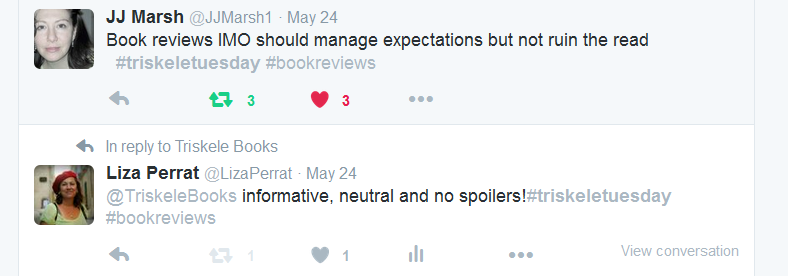
At our latest Triskele Books #triskeletuesday fortnightly twitchat, on Tuesday 24th May, the (very animated!) topic of discussion was #bookreviews.

@TriskeleBooks starting off by asking what makes a great review:


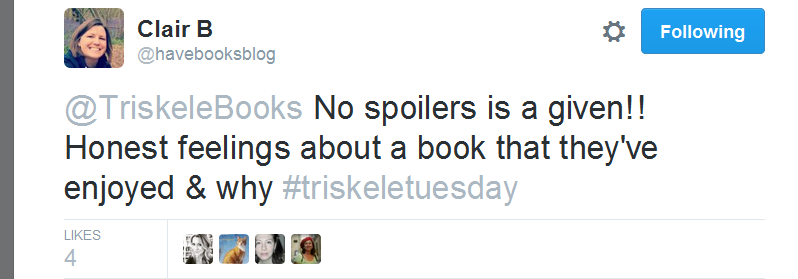
 And, at the opposite end of the scale, what makes a bad review, “spoilers” being top of the list:


 The star ratings system also provoked some lively comments:


All in all a friendly and interesting chat with the valuable opinions of some well-known book reviewers!


Please feel free to join us for our next #triskeletuesday chat on 7th June at 7.30pm GMT on the subject of #bestvillains.