Friday, 26 February 2016

Book Club: Patricia Sands, author of the Love in Provence series


 Review and interview by Liza Perrat


For this week’s Triskele Bookclub, I’d like to introduce Canadian author, Patricia Sands. Patricia writes women’s fiction novels set in Provence, France and her own love affair with this country certainly shines through in her vivid descriptions of the history, customs, food, wine and beautiful landscape.

I have greatly enjoyed the first two novels of Patricia’s Love in Provence series: The Promise of Provence, of which my review first appeared on Bookmuse, and the second, Promises to Keep.


LP: Patricia, I believe you spend a part of the year in France? Whereabouts, and when did this love of France start?

PS: I’ll answer your last question first. My love affair with France began fifty years ago (Yikes! I’m always shocked when I say that out loud!) and has continued to grow into a full-blown romance. I’ve been fortunate to visit most regions of the country throughout my life on vacation. Then, for the past twenty years, my husband and I have spent extended stays varying from one to five months. We often fly through Paris and stay there for a week before heading south to the Côte d’Azur. Nice and Antibes are where we settle most frequently and our side trips are based from there. Since I began writing novels set in France in 2011, much of our exploring revolves around research I’m doing. It’s all a labour of love.

LP: Can you tell us a bit about the Women's Travel Network?

PS: This is an offshoot of Worldwide Quest travel company. WTN is Toronto-based and provides excellent trips for small groups of women. In 2014 they invited me to work with them to develop a tour based on my novel, The Promise of Provence. We spend five days in Nice with daily visits to places like Eze, St. Paul de Vence, Grasse, and, of course, Antibes. Then we travel to Avignon, with a stop in Aix-en-Provence along the way. During our five day stay in Avignon, we also explore the countryside of Provence. The trip is planned in June while lavender is in bloom. It’s a fabulous holiday and I love going along to share the places I write about. My friend and fellow author, Susan Sommers, co-leads the tours with me. We did two in 2014 and another is planned for 2017.

LP: What triggered the idea to set your novels in France?

PS: After the success of my first novel, The Bridge Club, I knew that I wanted to continue writing stories about older women. Because of my love for the south of France, it only seemed logical to set The Promise of Provence in that location. We lived in Antibes for five months while I wrote the first draft and, to be honest, if we did not have such a lovely big family in Canada, we would live there forever! Never mind, I’ll be happy with visits and living there in my books. I had no idea that The Promise of Provence would turn into a series. I heard from so many readers who wanted more of Katherine’s story that it was a pleasure to continue. The final part of the trilogy, I Promise You This, will be released by Amazon in May and is available now on pre-order. Although there is romance in these stories, the novels are more about a dramatic mid-life change in the life of Katherine Price after her husband suddenly leaves her. Location is like another character in my writing and my readers say they feel like they are in France as they read. That pleases me!


LP: I believe you’ve moved from independent publishing now? Can you tell us a little about the Lake Union Publishing imprint (Women's Fiction) of Amazon Publishing, and why you think you were approached by them?

PS: I was happily working away as an indie author, thanks to the amazing collegiality of that community and the support we all offer each other. Out of the blue, in January 2015, I received an email from a Senior Acquisitions Editor with Amazon’s Lake Union imprint. They were interested in acquiring the rights to my Love in Provence series and signed me to a contract. I have to say I was very proud to receive that invitation. One of the things they mentioned was that they became aware of me through my presence on social media and also the number of high reviews for my books. So, to all writers who get annoyed with the demands of social media, I say keep at it!

LP: What made you decide to publish with Amazon, rather than continuing to independently publish?

PS: I honestly don’t think I would have signed with anyone but Amazon. The primary reason being that they never stop promoting your book, even after that first rush of sales. That’s often not the case with traditional publishing houses. However, I still have the rights to The Bridge Club independently and can continue to self-publish in the future if I choose. I fall into the “hybrid” category, which I think is the best of both worlds.

LP: Do you have any input in the publishing process? If so, what?

PS: The support Amazon has offered has been most impressive. My editor is always available to discuss anything. All of the support I’ve received through the process of developmental editing, copyediting, proofreading, marketing, has been professional, friendly and first-rate. I’m definitely a fan. I have felt very included in the entire process. Cover development, promotional wording are all worked on together.

LP: Are you happy with this decision and will you continue this form of publishing?

PS: I am very happy with my connection with Amazon and they have first right of refusal to my next work. However, I have no qualms about continuing with independently published work as well. I love being part of the writing community and making the international connections that are so easily developed these days online. It’s an exciting time to be a writer.

LP: Can you give us any hints about the next story in the Love in Provence series?

PS: The third novel, I Promise You This, actually begins in Toronto where our protagonist, Katherine, has had to urgently return. When she does get back to France, the story lingers in the Loire Valley for a change of scene and then back to the Côte d’Azur (oops … that may be a spoiler …), where more surprises await. I’m actually going to continue with another trilogy that continues the lives of these characters, so I’m excited about that. Readers have asked and I’m thrilled to comply.

LP: It’s been lovely chatting with you, Patricia, and we wish you much ongoing success with your writing and your travels.

Thank you for inviting me. I’m a big fan of the Triskele group and it has been my pleasure to chat with you, Liza.

Patricia Sands lives in Toronto, Canada, when she isn’t somewhere else. An admitted travel fanatic, she can pack a bag in a flash and be ready to go anywhere … particularly the south of France, for her annual visit.

As of January, 2015, along with being a proud indie author, Patricia is also delighted to be under contract with Lake Union Publishing for her Love In Provence series. This is the women’s fiction arm of Amazon Publishing.

With a focus on travel, women’s issues and ageing, her stories celebrate the feminine spirit and the power of friendship. Encouraging women of all ages to stare down the fear factor and embrace change, Patricia has heard from readers (men too!) ages 20 to 83.

Her award-winning debut novel The Bridge Club was published in 2010 and the audiobook, read by Patricia, will be available soon.

Her second novel, The Promise of Provence received a 2014 National Indie Excellence Finalist Award in Literary Fiction. An Amazon Hot New Release in April 2013, The Promise of Provence was also a USA Best Book 2013 Finalist ~ Women’s Fiction.

Thanks to reader requests, The Promise of Provence, set in the south of France, became the beginning of the Love In Provence series. Promises To Keep, Book 2 in the series, was published in 2014. The rights to the series were then acquired by Amazon’s Lake Union Publishing, who relaunched Books 1 and 2 in October, 2015 and will publish I Promise You This (Book 3) in May, 2016. This last book of the trilogy is now available for pre-order on Amazon.

In June 2014, Patricia led two 10-day tours of the French Riviera and the countryside of Provence. These trips were based on The Promise of Provence, with the Womens Travel Network. Let her know if you would like to go with her and a small group of women. It’s the perfect trip for women traveling on their own or with good friends. She is already counting the days to the next tour which is scheduled for June 2017.

Find out more at Patricia’s Facebook Author Page, Amazon Author Page, Goodreads or her blog where you will find links to her books, social media, and monthly newsletter. The latter, sent once a month, contains special giveaways as well as her photography and information about the south of France, her home away from home. She would love to hear from you!

Thursday, 18 February 2016

Male Romance Authors - Interview with Charlie Maclean

By JJ Marsh

This week we welcome Charlie Maclean, author of Unforgettable – a funny, thoughtful, touching contemporary romance with a premise similar to that of Sliding Doors. What if we could live two parallel paths resulting from the decision of a moment? see review here

Before talk to Charlie, let’s take a minute to look at the genre. Contemporary modern romance, with pastel-shaded covers featuring silhouettes in high-heels and glitter, is dominated by women. Both as readers and writers. Indeed, occasional foolish debates flare over whether or not men can even write romance.

Tsk.

Of course men can write romance, and women can write science-fiction and anyone can write in any genre. Your gender dictates what you can do with your body, not your mind.

Here are ten of my favourite contemporary modern romances written by men, just to prove my point. In chronological order of reading


High Fidelity, by Nick Hornby
What it really means when you make someone a tape

Scratch, by Danny Gillan
There's a love story at the heart of this, but it isn't the one you think

Man and Boy, by Tony Parsons
Coming-of-age, but it’s the adult who grows up

My Fat Brother, by Jim Keeble
Idleness won’t cut it when the Barron brothers meet love, tragedy and a penguin

Time for Bed, by David Baddiel
Observations on ego and obsession, with fabulous set-pieces and blistering lines

The Rosie Project, by Graeme Simison
Love as disruption told by an exceptional voice

Things My Girlfriend and I Argue About, by Mil Millington
The daily joys of cross-cultural married life with wickedly funny characters

The Humans, by Matt Haig
People and dogs as observed by someone who doesn’t do relationships

Us, By David Nicholls
Like Simison, Nicholls creates a character love changes for the better

Unforgettable, by Charlie Maclean
Tones of Shakespeare, but tragedy or comedy?


Over to our guest this week – Charlie Maclean...

 
Charlie’s debut novel, Unforgettable, is a sexy, gritty tale of present-day star-crossed lovers. 
As a passionate storyteller he has also drafted TV and films scripts. 
He lives between London and Brighton (UK) and is currently working on his next book, also a love story, this time set in Brighton. 

Details at charliemaclean.co.uk


Which work most influenced you when growing up?

Some early favourites were I Am David by Anne Holm and Goodnight Mister Tom by Michelle Magorian.

Where do you write?

I have my laptop or notebook with me at all times. At home, my writing desk is a square card table with fold-out legs and a green felt surface.

Who or what had the biggest impact on your creative life?

Tough question! I’ve never had a writing mentor; my writing has developed from reading lots of books and feedback from editors.

How far are you influenced by other media, such as music, TV or fine art?

Film and TV are particular influences. I’d love to see Unforgettable dramatised.

Do you have a phrase that you most overuse?   

I always try to be original.

Which writers do you enjoy?

There are so many. I’m going to say two great favourites, Iris Murdoch and William Boyd.

Why do you write?

It’s something I’ve always done and always felt the desire to do. I love stories and trying to find some human truth through them.

What makes you laugh?

My dear friends.

Do you have a guilty reading pleasure?

Rereading my favourite books rather than ones from my to be read pile.

Which classic do you wish you’d written?

The End of the Affair by Graham Greene

Which book impressed you most last year?

It didn’t come out last year but my favourite read was This Is How You Lose Her, the collection of short stories by Junot Díaz.

Would you share what you’re working on next?

My next novel – also a love story – this time set on the South Coast of England, in Brighton.

Wild card: What’s the best way of spending a Sunday morning?

A couple of hours of writing, a run, then breakfast with strong coffee before climbing back under the bed covers, ideally with someone special.

Friday, 12 February 2016

Triskele Tuesday #litfests

On Triskele Tuesdays, the team get online for an hour (19.30GMT) and discuss a current issue on the literature/publishing scene.

If you've not participated in one of our Twitchats before, simply search for #triskeletuesday and join in. All opinions welcome.

On Tuesday 9 February, the Triskele Twitchat tackled LitFests.

#triskeletuesday #litfests
We posed a few questions: why, how, who and what for?

The Human Library at Chorleywood LitFest

Which are the best 'little' litfests out there?

Twitter came back with a flurry of replies:

Hay-on-Wye
Harrogate
Chorleywood


@L1bCat recommended Not the Oxford Lit Fest
HNSOxford
Stokey LitFest


Crouch End
Wray Castle for children
@brixtonbard flagged up BareLit 


Lewisham
@JJMarsh1 mentioned non-UK Züriliest
CrimeFest in Bristol 
(where the bar is a crime scene in itself according to @sheilab10 and @ChrisLongmuir)


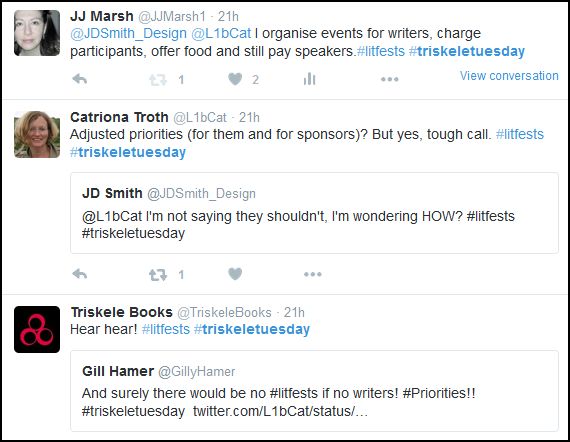
Should litfests pay their authors?
Or should writers be grateful for the 'exposure'?


And is festival programming broad enough?

 The consensus is that readers are ready for anything. The problem is programmers playing safe.


In summary, readers and writers are interested in variety. They attend litfests to find out more about the books and authors they love, and to meet other readers. Writers felt very strongly that if caterers and venue hire is paid for, why not offer remuneration to the main attraction? Sponsorship was mooted as one option. Another element not mentioned overtly but clear from the discussion was how much enjoyment writers get from meeting their readers and other writers.

Conclusion: there's life in the litfest yet.


Next #triskeletuesday twitchat will be on 23 Feb on the subject of #comfortreads


Friday, 5 February 2016

Book Club: Jackie Griffiths, author of Ox Herding

 by Barbara Scott Emmett

I reviewed Jackie Griffiths’ prize-winning novel, Ox Herding for Bookmuse a little while ago. I was very much impressed by the way the metaphysical subject matter was tackled. 
Through a modern woman’s spiritual search, the novel explores a classic Chinese treatise and shows its relevance to a contemporary search for truth and meaning.

 Here Jackie talks about writing Ox Herding and winning the Quagga Prize:


“Too many judges turn straight to the front matter to examine the name of the publisher, read the reviews, and take on board what others have said about the book – but they don’t seem to care as much about the content itself.”

This was the passionate complaint of a judge in a recent indie book awards competition, and he was saying it in relation to my philosophical novel, ‘Ox Herding: A Secular Pilgrimage,’ which recently won the 2015 Quagga Prize for Genre Fiction. It was my first book as a professional writer – a career I had wanted to have since I was very young.

‘Ox Herding’ was a novel that I simply had to get out and onto paper before I could write anything else. It’s a subject close to my heart and was something I needed to complete before turning my mind to other things. The book is a philosophical novel about a secular pilgrimage, a fateful journey of self-discovery in which the main character struggles to escape her belief systems and eventually combats and transcends the power of her own ego.

My interest in this field was sparked by a life-changing discussion I had with a friend of the family when I was just fourteen. The friend later sent me a copy of The Ten Ox Herding Pictures, a Chinese philosophical classic depicting this journey to enlightenment, and which sparked my life-long interest in human metaphysics.

According to the Ten Ox Herding Pictures, the ox (or bull), represents the ego and its total power and total dominance over our thoughts and behaviour. Herding the ox is a metaphor for recognising this problem, directly confronting it, and eventually ridding ourselves of its power enabling us to live in a kind of extended truce. In this state of permanent moratorium it is possible to find true freedom.

I knew exactly what I wanted to write; that there would be ten chapters, and right from the beginning I knew what each chapter should be about. The shape of the book was quite clear. Once I had the idea to express the Ten Ox Herding Pictures as a novel, it was simply a matter of putting fingers to keyboard, letting it all out, and getting it done.

Winning the Quagga Prize was a great surprise and delight, and it was especially poignant to hear the judge’s words about how much he valued the literary content. I hope that my book sends a powerful philosophical message to readers, but one that can be clearly understood by anyone. Some rather complicated philosophical theories are presented within a Carrollesque adventure story, and I included a decoding section at the end for readers to be sure of meanings. There are several recent philosophers who explore these complex subjects, the Indian thinker and educator Jiddu Krishnamurti being the most noteworthy, but it is sometimes very difficult to understand the thrust of all the ideas. I hope that my book, Ox Herding, succeeds in this endeavour and that readers can ascertain the philosophical meaning as well as enjoy the plot.


Website http://www.jackiegriffithsauthor.com/

Blog http://www.jackiegriffithsauthor.com/blog/

If you're in the US, grab one of the copies of Jackie's book as an Amazon Giveaway! https://giveaway.amazon.com/p/d733b2bd0d28c45a

Friday, 29 January 2016

Meet the Editor: Catriona Troth

By JJ Marsh

There are many advantages to being in an author collective, the most valuable being the skills each member contributes. Many years ago, I spotted Catriona Troth on a writers’ critique site. Smart, perceptive, erudite, critical yet tactful, she was one of people I really wanted to read my work. In fact, it was Catriona who first had the idea of an author collective – a team based on mutual support. Unsurprisingly, she has now become a professional editor. We had a chat about how she does what she does so well.


What kind of editing do you do?

The first thing to say is probably that I am not a proofreader, or a copy editor. Nor can I give specific market advice. I am a structural editor, which is quite a different job.

My approach is to take a helicopter view of an MS and provide an overall report. In fiction, I am good at spotting where scenes need to be reorganised, say, and I will home in on inconsistencies and anachronisms. I do a close read of a manuscript, but I will typically make one or two in-line comments on average per thousand words – far fewer than proofreader or copy editor would.

I have also worked on a number of non-fiction proposals, helping authors to work out how to structure their ideas and present information. I spent twenty years writing reports based on technical data for a non-technical audience many of whom did not have English as a first language but who needed to understand the implications of the results. It gave me a good grounding in how to organise information so that it flows logically, and how to express it in a clear, concise and unambiguous way.

How would you describe a successful author/editor relationship?

The point of a critique is not to impose my vision on the manuscript. The story is and remains the author’s. Whatever suggestions I make must respect the author's own voice, style and intention. I always begin my report with the aspects I thought were strongest. And while I will be clear where my concerns lie, I focus on asking questions, offering reminders and suggesting developments, while encouraging the author to fill in the detail and find the solutions that work for them.

As for the author, they need to be able to take any criticism on the chin. But they also need to remember that the editor's view is just that - a view. If after they have listened to what the editor has to say and given themselves time to digest their comments, it still feels wrong, then they should stick to their guns.

Can you give some examples of your work?

Some of the aspects of a manuscript I focus on are:
  • Overall plot arc / Pacing 
JD Smith’s powerful series of short novels about the Palmyrian warrior princess, Zenobia, are fast paced and packed with action. But occasionally the early drafts fell into the trap of repeating in dialogue things that the reader already knew, or dwelling too long on passages where not much was happening.
  • Use of place
JW Hicks’s dystopian novel, Rats, is clearly set in a future version of Britain, but originally in no specific location. As a fan of the TV series, The Walking Dead, I knew how much that gained from being set recognisably in a devastated Georgia. I encouraged Hicks to ground the story in a landscape she knows well – the cities, mountains and valleys of south and west Wales.

  • Character development / sketched characters 
Again in Rats, the main character's love for her pet ferret leapt off the page. But I didn’t feel the same immediacy in her relationship with her lover, Striker. I pointed out a few scenes where taking us in a little deeper would draw out Bit’s feelings and engage the reader.

  • Voice, symbolism 
I hugely admired the virtuosity with which Barbara Scott Emmett created the ‘historical’ documents she threaded throughout her novel, Delirium, about a lost poem by Rimbaud. But when she wrote in the voice of Rimbaud’s teenage wife, I felt she let Rimbaud (and her own?) irritation with the young woman creep in, rather than fully inhabiting her mind.

I also encouraged her to bring out the full impact and symbolism of one shocking discovery along the trail of discovery.

  • Consistency over a series 
Your detective, Beatrice Stubbs, has now appeared in four novels, set in different European cities. Beatrice is a good detective, but she has certain defined characteristics and eccentricities which readers come to love. I try to spot and point out whenever she veers away from those (such as when, as a noted gourmet, her response to an invitation to dine aboard a large cruise ship was less snobby than I might have expected).

  • Fact checking
I am always fairly good at spotting where facts need to be checked, and will either check them myself or suggest that the author checks. But as my mother came from the Welsh speaking family and I know Anglesey well, Gillian Hamer has had a particularly hard time from me - querying everything from geology to how to give a dog commands in Welsh!

  • Sources and copyright
I am very conscious of how important it is for authors to acknowledge their sources and to check copyright for quotations etc. Copyright law, and the concept of fair usage, varies between territories, so in this age of global publishing, it is particularly incumbent on authors to ensure that they remain within the law.


One of the manuscripts I worked with in most depth was the third book in Liza Perrat’s The Bone Angel trilogy, Blood Rose Angel, the story of a midwife battling the plague in medieval France. Early drafts of the novel suffered from two problems. First, Perrat’s passion for her subject had allowed her research to get in the way of the story. Secondly, there was a structural problem with the development of the plot lines. Rather than allowing a build-up of people and circumstances ranged against her lead character, Heloise, till she reached her lowest point, Perrat was either starting at too low a point (in one version) or allowing a normal, untroubled state to continue too long (in a second).

In this case, I offered a report covering:
  • Development of particular characters
  • Trajectories of particular plotlines (such as the progress of the disease, the impact of the disease on village life, the attitude of the villagers to Heloise, and Heloise’s relationship with her husband)
  • Use of language to suggest a historical period
  • Themes and symbolism
  • Structure, pace and ending
In addition, I provided a marked up copy of the manuscript with specific questions that had occurred to me as I read, ranging from consistency re use of names to historical details such as when playing cards were first introduced to Europe.


How do you approach working with a new client?

If it's a writer whose work I don't know, I like to have an initial meeting (which these days can be via Skype) so I can understand exactly what the author is trying to achieve. After that, I am happy to offer an initial assessment of a chapter or two, just to be sure that we both feel we can work together.

For fiction, I would then read the whole MS and return a report that gives both an overview of its strengths and weaknesses and in-line comments pointing to specific issues.

The process for non-fiction can be more iterative, but my initial feedback is likely to include:
  • an initial map of how might be presented
  • suggestions for changes to the structure
  • an assessment of any gaps
  • some ‘friendly challenges’ about the ideas presented

What the clients say:

Liza Perrat: Catriona did a fabulous job of restructuring the entire plot for Blood Rose Angel. From an ill-defined, wayward storyline, she established a clear and solid plot arc, defining themes and symbolism. She also pointed out inconsistencies and anachronisms and told me to “cut the historical facts and concentrate on the story."

Gillian Hamer: Catriona's input into my novels has been invaluable from the first (The Charter). She has a natural editorial eye and sees things no one else would. She is encouraging and tactful, but also matter of fact when changes are needed. Consistency, story arc, accuracy and character development are only some things I rely on her for. Even if I don't always agree with every one of her suggestions, she always makes me think.

JJ Marsh: Every one of my books has benefitted from Catriona's gentle touch. Editing can be a particular kind of hell, as if you and your Precious are being beaten, slashed and made to do sit-ups. Somehow, Catriona makes the experience painless, almost like a therapeutic massage, from which you emerge clear-eyed and relaxed in the knowledge you have a far, far better book.

JD Smith: Catriona is more than a line-editor, she really gets to the heart of your book and the crux of the emotions between characters. She spots things no one else would, and really provides and indepth evaluation of the inconsistencies and narrative issues  my books face, not to mention making me check all my historical facts!

JW Hicks: Once Rats was, to my eyes, finished done and dusted I was reluctant to change a word. But Catriona’s illuminating editing removed the scales from my eyes and made me realise that my fictional future world needed grounding, needed deepening, needed to be made  ‘realer’.
That I achieved this, is all thanks to Catriona.   

To contact Catriona about editing, send an inital email to catriona[dot]troth[at]gmail[dot]com, with the subject line Editing Enquiry and some details about your MS.
For more information, see Library Cat Editing Services

Friday, 22 January 2016

Triskele Wants You!

One of our original ethics when we began Triskele Books was a commitment to supporting and developing other writers. That's why Jeff Norton dubbed us 'The Wu-Tang Clan of Publishing'.


We began with our Associate Programme, taking on authors whose work we loved. We offered experience and editorial/design/marketing support for a year. In return, those authors contributed to the Triskele team.

We initiated the Indie Author Fair, offering a pop-up bookshop for indie authors at Chorleywood LitFest. Foyles Charing Cross Road, and as part of the LBF Fringe Festival. Look out for the next one this April.


Now we're seeking for new ideas of ways to collaborate with other writers which will bring mutual benefits.
Triskele members are looking forward to a packed year of events and activity, including three new releases, so our time is limited. However, we are planning some short-term collaborative ventures. If you - author, bookseller, festival planner, publisher, arts organisation, author collective, artist or Prosecco manufacturer - have any innovative thoughts on how we can work together, we're all ears.


To provide some context, here are some facts but not limitations.

The Triskele collective writes historical fiction, crime and literary fiction.
Three of us live in the UK, one in France, one in Switzerland.
We're all indie publishers and, so far, all women.
Our triskele logo represents independence and mutual support.
Our key principles are high-quality writing, professional presentation and a strong sense of place.

For more info on Triskele and its members and how to contact us, here's our website.

http://www.triskelebooks.co.uk/


Friday, 15 January 2016

Book Clubs: Is It Really About the Book?

by Liza Perrat 

For today's post, I had the pleasure of speaking to some members of different groups to get their take on book clubs.

LP: Why did you decide to join a book club? And how long has your book club been running?

Lesley: For an excuse to go out and so I could get some suggestions for good books. 
Cathy: To find new books to read and because I love to eat out.

Deb: Because a friend I didn't get to see often asked me to join and as I loved to read anyway it gave me an opportunity to catch up more often. Our book club has been going for about 10 years and I was one of the original members.

Carol: As I knew the women involved would be fearless, feisty and forthright in their opinions of the books chosen and read. The book club has been running in excess of 5 years.

Gwen: To introduce me to books that I would not have heard of and sometimes not likely to read. For the pleasure of discussing books with others who often have a very different interpretation to me. For the enjoyable social interaction.

Mandy: I joined a book club as 1 I love reading, I like talking about books and I thought it would add some greater variety to what I read. Our book club has been going for a few years with an ever changing cast and some originals.


LP: What's the best thing about belonging to a book club?

Lesley: Going out for dinner and I get to read books I wouldn't normally choose and of course the wonderful company!

Cathy: I get to read books I probably wouldn’t choose and I get to have a great night out.

Deb: The social interaction as well as the exposure to so many different books that I would not have come across otherwise.

Carol: Reading out of your genre comfort zone and the discussion about the chosen book as well as other current social issues.

Gwen: the social interaction is a big benefit … if the company was not enjoyable and too serious, I would not go.

Mandy: The talk, the social aspect, the regularity, the divergent views, the opportunity to wander off into other non-book chat.


LP: How do you choose which book to read? And do you find you end up with a wide range of books?

Lesley: We choose books from suggestions from friends in other book clubs, radio interviews, TVs Book club and online suggestions.

Cathy: From popular reads lists, Jennifer Byrne’s ABC book club and from recommendations from friends who are in book clubs.

Deb: We take turns choosing a book which does give us quite a range of genres.

Carol: The book selected for the month is chosen by the monthly host.

Gwen: the person who is the host the next month chooses the book and we end up with a wide range of books including non-fiction. About one book a year we all choose our own such as a non-fiction. This year I chose Darwin’s Armada, Iain Mccalman. 

Mandy: Every person has an opportunity to choose a book during the year and we make up a list for the coming months so people have a chance to read ahead if they wish. This also helps in planning the location as we rotate around people’s houses. It also accommodated the travel plans and other commitments people have.

LP: What's the gender/age range of your group?

Lesley: All female … eldest 55 down to 40ishes? Have I insulted anyone?

Deb: Our group consists of all females and the ages range from 40yo to a lady in her late 70's [at a guess].


Carol: Female between 60 and 85.

Gwen: all female, currently 8 members but usually less at a meeting as many are travelling, some still working part-time. 60-80 year age range. Must be left leaning as politics is always in our discussion! We have all been teachers except a librarian, most were principals of schools, so a very professional, well-educated group.

Mandy: We started as a mixed group and now it is female.

LP: What key elements make a book a good choice for your club?

Lesley: Interesting, likeable characters, well written, surprise twists … maybe that's just me.

Deb: The only stipulation that we have for a book to be a good choice is that it is readily available. After that we mostly leave it up to the individual. I say "mostly" because there is one person who has chosen Matthew Reilly twice and the rest of us found it too far-fetched so it is often bought up 'jokingly' [but not] that we can choose anything except M.R. Ha ha!

Carol: Availability; range of genres fiction and non-fiction including biographies.

Gwen: a book recommended by others, not too large to read in less than a month, that has some intellectual element such as historical fiction.

Mandy: Engaging plot and characters, not too esoteric, easily accessed.

LP: How useful do you find questions for book clubs prepared by the author? 

Lesley: sometimes questions at the end of a book make me laugh … feel like I'm back at school and have to analyse it … I’m only in for enjoyment.

Cathy: We don’t use them often. Occasionally they’re a good conversation starter.

Gwen: we don’t use questions but I think it would be useful to discipline our discussion that can divert from the topic!

Mandy: Useful albeit not used by all.

LP: What was your group's favourite read of 2015?
 
 Lesley: I think we liked Andrew Davidson’s The Gargoyle best last year.

Deb: I'm not sure which book was the best for 2015 [we did have a few 'dud's' more recently] but with no doubt the favourite of all time was The Pillars of the Earth followed closely by Cross Stitch by Diana Gabaldon. Lionel Shriver’s We Need To Talk About Kevin was the book that provoked the
most discussion even though it was not loved by all.


Carol: That would vary with the different members but I liked The Strays by Emily Bitto.

 
Gwen: The Golden Age by Joan London, Harper Lee’s Go set a Watchman and Spirit of lost Angels, especially having spoken to the author!!


Mandy: Given the divergent opinions in our group that would be hard to say for everyone. The session talking by skype to the author was a very big hit! Another one that proved popular was a genre/topic from which one chose one’s own read and then told the group about it.

LP: thanks for the plugs, Gwen and Mandy!


LP: Is it a very social occasion, with food and/or drinks too? Or rather more serious, and just discussion about the book.

Cathy: Definitely social, with lots of food and wine.

Deb: Definitely very social. We take turns having it at each other’s house for those of us who can and want to and alternate times we choose a restaurant. The person hosting the meeting provides the food: nibblies and the wine and drinks. We talk and laugh about everything while eating our meal and towards the end of the night we finally get around to discussing the book. Then we do the new book reveal and organise the time and place where we will meet next time. We start at 7pm and usually finish about 10.30pm but occasionally have partied on longer. Once a year we have an overnight trip somewhere nice and on these times we have been happy to not even talk about the book.


Carol: Definitely social with food and drinks.

Gwen: Yes, it is a very pleasant social occasion. We have nibbles and wine followed by cake and coffee after the discussion. We have to allow for chatter about travels, film, plays, other books and then we discipline ourselves to discuss the book! We do not have any guidelines for questions but we still have a very beneficial discussion.

Mandy: Definitely food drink and lots and lots of talk!!

LP: How often do you meet, and where? 

Lesley: meeting every 2nd Wednesday at local pub, Ryan’s Hotel 

Deb: We hold our meetings every 6 weeks as the full-time workers felt that they needed that long to finish a book. Even though I will read many more books in this time I find it works well, any longer would be too long especially if you missed a few and 4 weeks being a Friday night would take away too much from family time.

Carol: Meetings occur monthly and rotate at members’ homes.

Gwen: Once a month, 7.30pm to about 9.30 or later! We meet at members houses, rotating the venue.

Mandy: Monthly in members’ homes

LP: Do you find members have very differing opinions about each book?

Lesley: we usually do have varying opinions.

Cathy: yes most of the time.

Carol: Definitely

Deb: Regarding different opinions I find it interesting when people’s opinions vary considerably. It tends to be with books that may put forward religious, political or strong moralistic views. The people who rate the book poorly usually hold different opinions to those in the book and sometimes will not even finish reading that novel. Other times people can rate differently when they were or were not in the mood for that type of book. For example, they had read too many of that type just prior and were ready for a change or that their lifestyle at the time was conducive to something more humorous, light-hearted etc. Generally though our rating of the book is fairly close.

Gwen: No, some have stronger liking for some books than others. I like to hear their interpretations which is often something that I have not seen in the book.

Mandy: Yes sometimes but not always.

So, it seems book clubs are mainly a chance to get together with the girls for a bite, a glass of wine or five, and a good old chat. Oh, and of course, to discuss the chosen book! Thanks to all who answered my questions and raising my glass to book clubs!