Friday, 17 June 2016

Announcing the Triskele Lit Fest 2016


A LITERARY FESTIVAL:

adventures in reading

Building on our experience of running two Indie Author Fairs, Triskele Books imagined our ideal Lit Fest. One word sums it up:

INCLUSIVITY!

Author panels to draw in readers eager to explore the world of books
Indie authors and trade-published authors on an equal footing on the same platform
BAME authors invited to talk about their books, not about diversity
Authors paid a decent fee for their appearance 

True to the founding principles of Triskele Books and Words with Jam, we knew it was up to us to make it happen.

So this year, alongside the trademark pop-up bookshop of our Indie Author Fairs, we will be staging a series of author panels, each focused on a genre popular with readers. The panels will bring together authors to discuss why they work in their chosen genre - what they love about it, what its challenges are, and their own favourite authors. 

Our Preserving the Unicorn panel will explore how editors and authors work together when the text, at first sight, defies conventional wisdom about how a narrative ‘should’ be put together. Ground-breaking novels, by their nature, break the rules. How does an editor work to hone such a text, without destroying the unique magic the author has created?

Supported by Matador Books and Ingram Spark, we bring you the first Triskele Lit Fest.

We look forward to welcoming you to Lift in Islington on Saturday 17th September.


Booking will open SOON for those who want a table in our pop-up bookshop.

Keep an eye on the Triskele Lit Fest blog.


In the meantime, you can view some of the exciting panellists we have lined up for you here.


Friday, 10 June 2016

Bookclub Discussion: A Greater World by Clare Flynn.

In June’s Triskele Book Club we review Clare Flynn’s novel A Greater World.

About Clare: Award-winning author, Clare Flynn is a former global marketing director. She now runs a successful strategic management company, although most of her time these days is spent writing her novels.
Amazon Description: “When Elizabeth Morton hears her father wants her to travel to the other side of the world to marry a complete stranger, she thinks he must have lost his mind. This is 1920 and a woman has rights - she might still be too young to vote, but she's not going to be treated like a chattel. But she's reckoned without the brother-in-law she's always despised, who brutally shatters her
comfortable world, so she has no choice but to sail to Australia.

When Michael Winterbourne, a Cumbrian lead miner wakes up with a hangover after his engagement celebrations, he has no idea he is about to be the cause of a terrible tragedy that will change his life and destroy his family. When Michael and Elizabeth meet on the SS Historic, bound for Sydney, they are reluctant emigrants from England. They may start to hope their troubles are over, but they'll find they're only just beginning. 

A Greater World is set in the early 1920s, a period of transition between the old pre-World War One way of life and the post-War, with the coming economic Depression, major social change and the evolving role of women in society. It moves from the dales of Cumberland and the docks of Liverpool to Sydney and the beautiful Blue Mountains.”

Okay, ladies. Time for your feedback.

1. Parting thoughts at the end of the book?

(GEH) That I wanted to know more! I found the book quite a slow starter for me and it took quite a while for me to bond with the characters. But by the end, I had connected. Elizabeth and Michael had such a difficult and traumatic journey to get to that point, they more than deserved some happiness, but I couldn't help but think there had to be more twists along the way!

(CT) There was a sense of satisfaction that, after all the twists and set backs, the characters had found their resolution.

(JJ ) Yes, satisfying and sad in some ways, as some characters I loved didn't make it all the way.

(LP) I sympathised with the main characters immediately, so found the ending satisfactory.

2. Location is a big part of our Triskele brand, and this book certainly took us around the globe – how do you think the author handled the various settings of the novel?

(GEH) I enjoyed the attention to the detail in the location, especially in Australia. The description of the cottage, the remoteness and bleakness of it, really resounded with me. I liked the bustle of the town and how different it felt. Obviously, I've not been to the Blue Mountains (unfortunately) but everything felt right to me.

(CT) I spent six months living in the Blue Mountains (a long time ago!) so it was a pleasure to revisit them. The flashes of breathtaking beauty among the hardship suffered by the settlers and miners made the location feel very special.

(JJ) One of the things I enjoyed most was the exploration of environment and culture. I also got a sense of newness - not just for Elizabeth but of a country making its own rules.

(LP) Really enjoyed how the author evoked these regions, familiar to me in modern-day, but only imaginable during that period of history.

3. There was a lot of drama here, a lot of sadness and loss, how do you feel the author handled the balance?

(GEH) I think it's part of this historical drama genre that it does feel a touch heavy on melodrama for my tastes, but there was never a point I felt it was handled wrongly. Yes, Elizabeth had a terrible run of bad luck and her heart must have been made of strong stuff, but I've no doubt many women went through very similar experiences back then.

(CT) Yes, plenty of melodrama! But most of it arose out of hardships of Australia, compounded by the Depression, or out of the social restrictions of the time, so not gratuitous or tacked on for the sake of cheap thrills.

(JJ) I had the impression the author gave us a condensed experience of life for women in the country, all packed into one character's life. Women experienced all these things and we feel the injustice and pain keenly having seen them through one individual's eyes.

(LP) A realistic illustration of how it was for women (and men) during these difficult times in Australian history.

4. Which was your favourite character – and why?

(GEH) Elizabeth - for her inner strength and determination. The way she handled so many things throughout her life proved she had an exceptional character. I particularly like the way she handled her husband's business dealings after his imprisonment - no doubt she was a far more astute businessman than him any day!

(CT) Like Elizabeth herself, I grew very fond of young Will. With maybe one exception, all her characters grew in depth as the story progressed. Jack Kidd could have been a cardboard villain, but was allowed to be much more.

(JJ) Michael Winterbourne. I was also was delighted to see the relationship between Jack and Elizabeth change and mature. Some characters lacked nuance, such as Harriet, but I warmed to Verity, Will and of course, Elizabeth.

(LP) I felt most sympathetic to Will, but feel most of the main characters were well developed.

5. Did you find you were able compare this author’s authors writing style to any big names authors of the genre?

(GEH) I came to this genre early on, pre-teens probably, through reading my nan's battered copies of Catherine Cookson novels and there is something reminiscent about Flynn's writing in her approach of building a rags-to-riches story but also of developing strong female leads.

(CT) Yes, Cookson is an obvious comparison, and hence her literary succession, Margaret Graham. It's not a genre I read widely in, but I remember many years ago reading a novel about a female convict sent to Australia who managed to build a life out there. Although it was set in an earlier century, A Greater World reminded me of that.

(JJ) The epic reach of such a novel and the tribulations endured reminded me of The Thorn Birds, with the echo of forbidden love. Another example which came to mind but set in a very different location was Isabel Allende's Portrait in Sepia.

(LP) Yes, I recently re-read The Thornbirds too, which A Greater World brought to mind. I don't really read this genre much though.

6. Research is obviously critical in historical fiction – how do you feel the author handled the period research?

(GEH) I thought it was handled very well. There were none of the dreaded info-dumps where I becomes clear the author has done their research and is determined not to waste it! As I said, I don't know the area or the period, but I have every faith in the author's ability. If I had to point out one area, I think the illness and doctor scenes were particularly strong.

(CT) I felt that the strands about mining in Australia, and also the legal system (which becomes quite important) felt as if they were well handled. You felt the presence of a confident knowledge, without having it rammed down your throat. There is also a scene that pivots on the visit of the Prince of Wales to Sydney that was very vividly drawn - good news of an event that must have been headline news!

(JJ) Agreed. Subtly woven and consistent so the reader understands the precarious and vulnerable nature of life in a small mining-town, as a child, as a woman, as anyone with something they wish to protect.

(LP) I enjoyed learning about this period of Australia's history and didn't feel information was dumped at all; cleverly woven though the narrative, it brought the period to life. 


7. How do you think the author handled the multiple POVS?

(GEH) I liked both Michael's and Elizabeth's stories, both worked well and we had enough background on each that we understood where they came from and why they were the people they were. I wasn't so keen on Harriet, I didn't find her POV as believable, or necessary if I'm honest. But I thought the dual roles worked very well and moved the story on very well in terms of pace and drive.

(CT) I agree. I think it was important that we understood both Michael's and Elizabeth's point of view. Each added pathos to the other's story.

(JJ) Both worked in harmony to deliver dramatic irony and pull the reader's sympathy in opposite directions. I agree the background was crucial to character development. Also agree Harriet was extraneous and less plausible. But one thing I really enjoyed was seeing the glimpses of other personalities through our MCs' eyes.

(LP) Definitely enjoyed seeing both sides of the coin, from the two main characters' POV. Agreed, wasn't too keen on Harriet's, as I think her actions spoke loud enough.


8. Would you look to read more novels by this author?

(GEH) Yes, I definitely would. It's a genre I don't read enough. And it's made me want to revisit Catherine Cookson again, which would no doubt make my nan smile!

(CT) Yes, especially if she were writing of a period or location that appealed to me.

(JJ) Yes, definitely and would recommend them to people I know would love these books. My instinct tells me this is an author who will take me to unusual places and allow me the intense experience of unfamiliarity and excitement. With the added interest of a personal journey. I already bought Kurinji Flowers.

(LP) Yes I would, to learn about other time periods in different settings.


Friday, 3 June 2016

#triskeletuesday #bookreviews


At our latest Triskele Books #triskeletuesday fortnightly twitchat, on Tuesday 24th May, the (very animated!) topic of discussion was #bookreviews.

@TriskeleBooks starting off by asking what makes a great review:


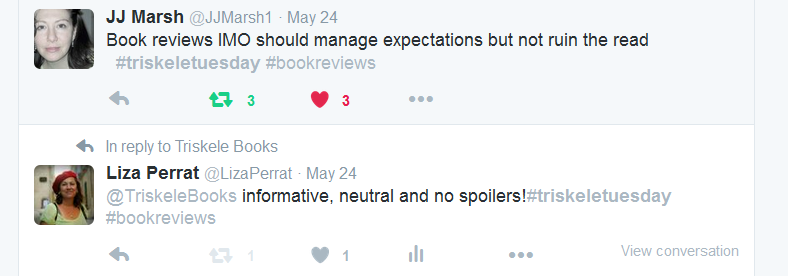
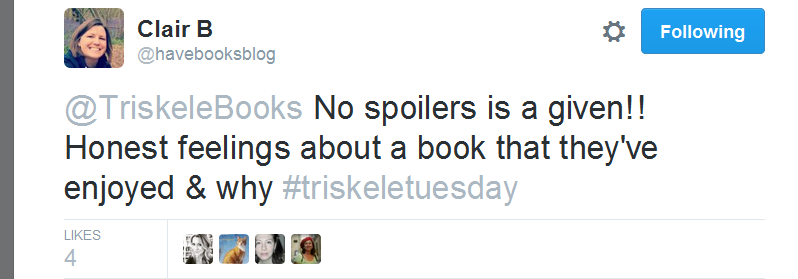
 And, at the opposite end of the scale, what makes a bad review, “spoilers” being top of the list:


 The star ratings system also provoked some lively comments:


All in all a friendly and interesting chat with the valuable opinions of some well-known book reviewers!


Please feel free to join us for our next #triskeletuesday chat on 7th June at 7.30pm GMT on the subject of #bestvillains.


Friday, 27 May 2016

Triskele’s Creative Spark


Summertime! Well, almost...

Same as last year, we're taking the summer months off to improve our writing. But this time, we invite you to come along for the ride.
 
We’ve bagged fifteen expert international tutors - including such luminaries as Emma Darwin, Amanda Hodgkinson and Jessica Bell -  to tackle one specific area of technique/style. We are officially excited!


Starting July 1st, for ten consecutive weeks, we’ll post an exercise every Friday. No cost, no commitment, just take what you want, when you want.

Each exercise is designed to last no more than half an hour, but all have suggestions for further exploration.

If you like, share your work/opinions/suggestions in the comments. But if you’d rather keep the results quiet, fine with us. Write like no one's looking!

Here’s the programme:

Triskele Books Creative Spark
  • Story Fundamentals
  • Plot and structure
  • Character
  • Point of View
  • Voice
  • Polished prose
  • Subtext
  • Location & setting
  • Theme
  • Sensory detail

See you on the first of July!

With grateful thanks to Triskele’s Global Partner, Ingram Spark. 


Friday, 20 May 2016

Top Dos and Don'ts for writing Book Reviews

By Gillian Hamer


As part of the Bookmuse arm of Triskele Books, I am proud that our work in supporting fellow authors was recognised by Goodreads last month, voting us one of their Top 1% Reviewers.

During a recent internal discussion about a new review we had received for consideration, it occurred to me that there is a real art and skill to producing a top quality book review. Something we have learned as second nature over time, does actually need a lot of thought and process to produce.

‘If you want to make an author smile, then review their book’ is something often seen quoted online. But in all honesty, a badly constructed review can often be worse than none at all.

I thought it might be helpful to other readers, new to reviewing, to put down a few of the unspoken ‘rules’ we follow when reviewing books for Bookmuse.

Here’s a summary of some useful Dos and Don’ts to consider:

DO

Try to stick to the 30% rule – that is to say have no more than a third maximum of the review made up of a resume of the novel. The reader wants to read it for themselves!

Stick to the job in hand – Whilst it’s fine to offer personal recommendations, keep to the book content and don’t meander off topic or bore readers. A location may well resonate with you but others won’t care where you spent your childhood holidays!

Have a list of questions you keep in mind when writing a review – and by the end of the piece try to answer as many of them as possible. Eg: Strength of characters, believability of plot, pace and style, dialogue and voice. Try to cover all of these in your feedback.

Remember why you’re writing the review in the first place – to inform prospective readers about your honest thoughts on the book. This isn’t about you, so you should take a back seat.

Support an author – remember not all books will be to your taste. That doesn’t mean you should hammer the book because of it. Keep that in mind along with the motto ‘if you can’t be nice, be polite.’ Writers are humans first and foremost.

Include comparisons if you can – authors need their egos stroking now and then. If a book really did put you in mind of another book by a bestselling, established author, don’t be afraid to say so.

Always be honest about recommending a book. That’s one of the best things you can offer an author.

DON’T

Never let your own personal tastes run away with you in a book review, trust me the reviewer usually comes out looking worse than the author.

Try not to call the author anything other than their full name or ‘the author’. Even if you know them it doesn’t need to be in the review, keep it professional at all times.

Avoid clichés and be original. The book may well be a ‘page-turner’ with a ‘nerve-wracking climax’ that was totes ‘unputdownable’ – but you can do better than that, right?

Take care with spoilers – there really is no need or excuse for them. You may have been shocked when the main character was killed in chapter one but does that need to be in a review? Even if you can’t be wholly positive about a book, there’s no need to spoil it for anyone else.

Never copy and paste the synopsis of the book into a review – it’s lazy and pointless. We all know how to Google!

Never use a book review as ‘payback’ for a poor review on another book – leave that to the schoolyard.

Never engage in debate about a negative review – smile, say thank you, and move on. If it’s your own book it can only end badly, and if you are trying to support an author, it only gives it more publicity.

Remember writers are human too – there are always ways to give negative feedback in a positive manner.

Finally, remember reviews are all personal opinion. You are entitled to your opinion just like anyone else. It doesn’t make you right or wrong. Your view is one among hundreds.

For a taste of our reviews, please sign up for our weekly Bookmuse newsletter here

Friday, 13 May 2016

#Triskeletuesday #Historicalfiction

At our last @TriskeleBooks #triskeletuesday fortnightly twitchat onTuesday, 3rd May, we discussed #historicalfiction.


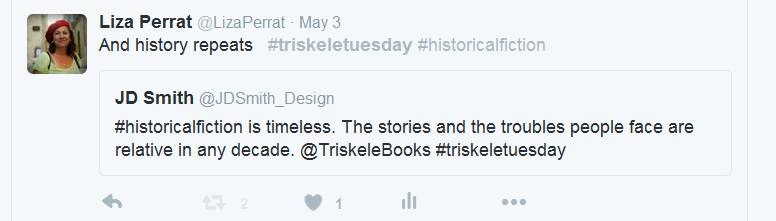
We started off by discussing that historical fiction appeals to contemporary minds because stories, and characters' problems and conflicts, are timeless.


We spoke out our favourite time periods...


 And female authors writing from a male POV:


And of course, being historical fiction, research was discussed...


Please come along and join us for our next #triskeletuesday chat on 17th May at 7.30pm GMT on the subject of #bookreviews


Friday, 6 May 2016

Bookclub Discussion: The Paying Guests by Sarah Waters

Welcome back to our new-style Triskele Book Club where, each month, we will discuss a novel the Triskele girls have recently enjoyed. Please feel free to join in and leave a comment. Let us know what you think of this book, even if you don’t agree with us!

Firstly, a few links to our Bookmuse Reviews of The Paying Guests, Sarah Waters’s sixth novel.

JJ’s first line of her review of The Paying Guests on Bookmuse: Like an old-fashioned kettle on the stove, this takes a while to come to the boil. But when it does, the steam and whistles could blow your head off.

Gillian’s first line of her review of The Paying Guests on Bookmuse: Wow. Wow, wow, wow. I LOVED this book. One of the times when you felt bereft as you neared the conclusion and so slowed your pace to make it last longer. Those kinds of books don’t come round too often for me.

Amazon Description: It is 1922, and London is tense. Ex-servicemen are disillusioned, the out-of-work and the hungry are demanding change. And in South London, in a genteel Camberwell villa, a large silent house now bereft of brothers, husband and even servants, life is about to be transformed, as impoverished widow Mrs Wray and her spinster daughter, Frances, are obliged to take in lodgers.


For with the arrival of Lilian and Leonard Barber, a modern young couple of the 'clerk class', the routines of the house will be shaken up in unexpected ways. And as passions mount and frustration gathers, no one can foresee just how far-reaching, and how devastating, the disturbances will be.


First off, how do you feel the author evoked life in 1920s London so well?

GEH: I listened to the audiobook version and I do think the narration added to the overall feeling of the period. For me it was nice to have a POV from the little-heard upper-middle-classes, whose voices aren't usually the most prominent in any historical fiction. I liked the fact there was nothing really special about Frances and yet her life still unravelled in such spectacular style - yet still in a quiet and controlled manner as befitted their class! Research was so subtle you barely thought about it and yet it was certainly there from the stockings they wore to the descriptions of London streets and the references to the class system in society.
JJ: I listened to this as an audiobook narrated by Juliet Stevenson, which added certain nuances to the novel. The difference in accent reminded me of how much more important social class was almost a hundred years ago. So in fact, the women are breaking not only one but two taboos.
The detail of the house and the effort it takes to make the thing function is an understated but powerful feature which underscores the above.
LP: As opposed to my colleagues, I read the ebook. So JJ's comment about different accents for different classes, is interesting as that's something I didn't pick up from the written word. However, for me, the author's attention to the most minute detail of everyday life is what really evoked this time period so well.


The Paying Guests has been described as “A masterpiece of social unease”. Do you agree, and why?

GEH: I'd not heard of that but I certainly wouldn't disagree. There seemed to be a feeling of frustration and inadequacy thought every aspect of the story. Not only in Frances but in her tenants and even her friends. There was the echoing aftershocks of WWI hovering over everyone and it felt no one could really get on with their lives. Of course there was also the ever-present class divides and the issues of same sex relationships. So much that went on behind closed doors that was never spoken about openly. I think the author did a brilliant job making even the reader feel uneasy.
JJ: The fallout of WWI is tangible, across the board. Broken, angry men wandering the streets, families destroyed, women taking charge and a sense of compromise or ‘making-do’ pervades the book. It’s an upset of social norms which was only ever meant to be temporary. But once society has been changed by circumstance, it won’t automatically revert. For the period, the events of this book are scandalous, yet the reader wholly believes how it might happen. Uncertainty makes anything possible.
LP: I would agree. It certainly brought to life social unease in several forms for me, through the disturbing aftermath of WWI paralleled with the social class differences, as well as the differences in each human relationship.


There’s certainly romance in this tale, but is it ONLY a love story?

GEH: I must admit I wouldn't class it as a love story at all. It's much more dark than that. I think regardless of whether it's same sex relationships or not this story could put you off for life! It's more about secrets and lies and life lessons than love for me.
JJ: It reminds me of EM Forster’s Maurice. That too is a same-sex love story but it’s about so much more. It’s about class, each social strata tightly bound to expectations of behaviour which are impossible to escape. The Paying Guests is about jealousy and power, not to mention how the tension of secrecy can rend the fabric of love.
LP: certainly there is SO much more than romance to this story ... it's about human relationships, good and bad, secret and deceitful, and the life-changing effects our decisions can have on our relationships with other people.


Do you have a favourite character, and why?

GEH: No. I couldn't really name any of them as a character that I connected with, for lots of reasons really. I certainly understood Frances and her motivations, but I didn't find her particularly likeable or found myself willing for a happy ending for her. I think Sarah Waters has that talent though. I felt the same about The Little Stranger and The Night Watch. The plotlines are gripping but I didn't find the characters all that engaging. I feel the author purposely tries to make us keep our distance and it's a distinctive style I really like.
JJ: No. I think Sarah Waters managed to makes me like, understand, despair of and laugh with the main characters from time to time.
LP: as my colleagues have said, I didn't really engage with one character over the others, which has been the same with all her novels. However, I felt each character was very well drawn, and I could easily imagine them.

What were your thoughts as you read the last page?

GEH: Really sad, have to say I have listened to it twice now, and the second time was just as good, but for different reasons, knowing what I knew about the ending - if you know what I mean!
JJ: That I wanted to go back to the beginning.
LP: I enjoyed it immensely, but wasn't sorry it ended. I'd had enough of this story and these characters by then.


I know all of Triskelites are great fans of Sarah Waters’s novels. Would you say The Paying Guests is your favourite? If not, which one?

GEH: No, I think that stays with The Little Stranger. This novel is very different and with none of her books can you really compare apples with apples. It was brilliant in its own way, but not quite up there.
JJ: I thought The Paying Guests was a wonderful but as to my favourite? Can’t decide between Fingersmith and The Little Stranger. I guess the difference is that I would read Fingersmith again and again. The Little Stranger scared me so much, I don’t need to read it again. Even thinking about that scene in the nursery still gives me a shiver.
LP: For me, Fingersmith, with its brilliant plotline and storytelling, stands out as my favourite.

For more details about Sarah Waters, refer to her website.

Are you a fan of Sarah Waters? If so, we'd love to hear your opinion on The Paying Guests, or any other of her novels.